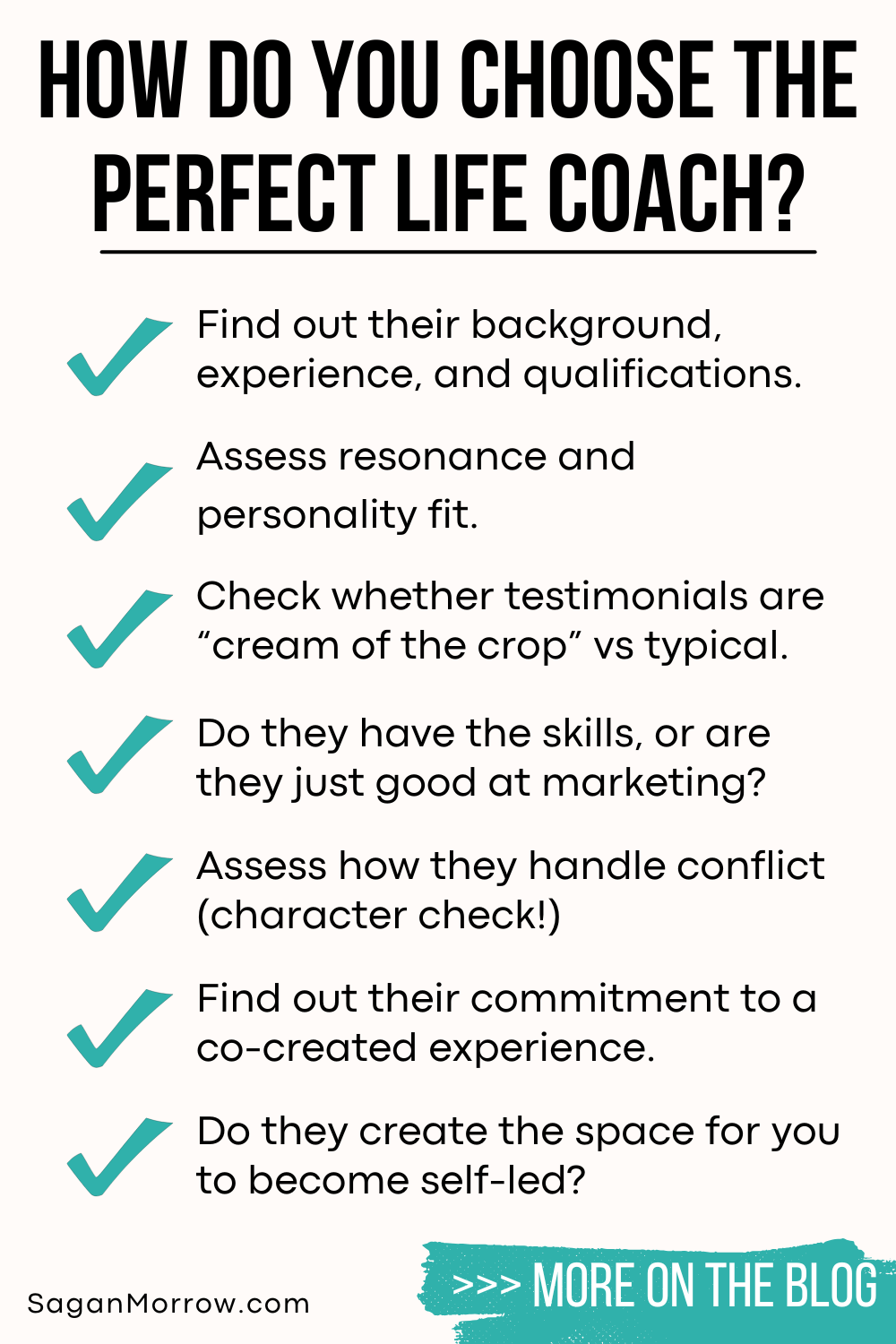
You are READY to hire a coach! …But what should you look for when you're hiring a coach? What makes a coach a good fit for you? How do you choose which coach to hire?
It can be overwhelming when you're not really sure what you should be looking for!
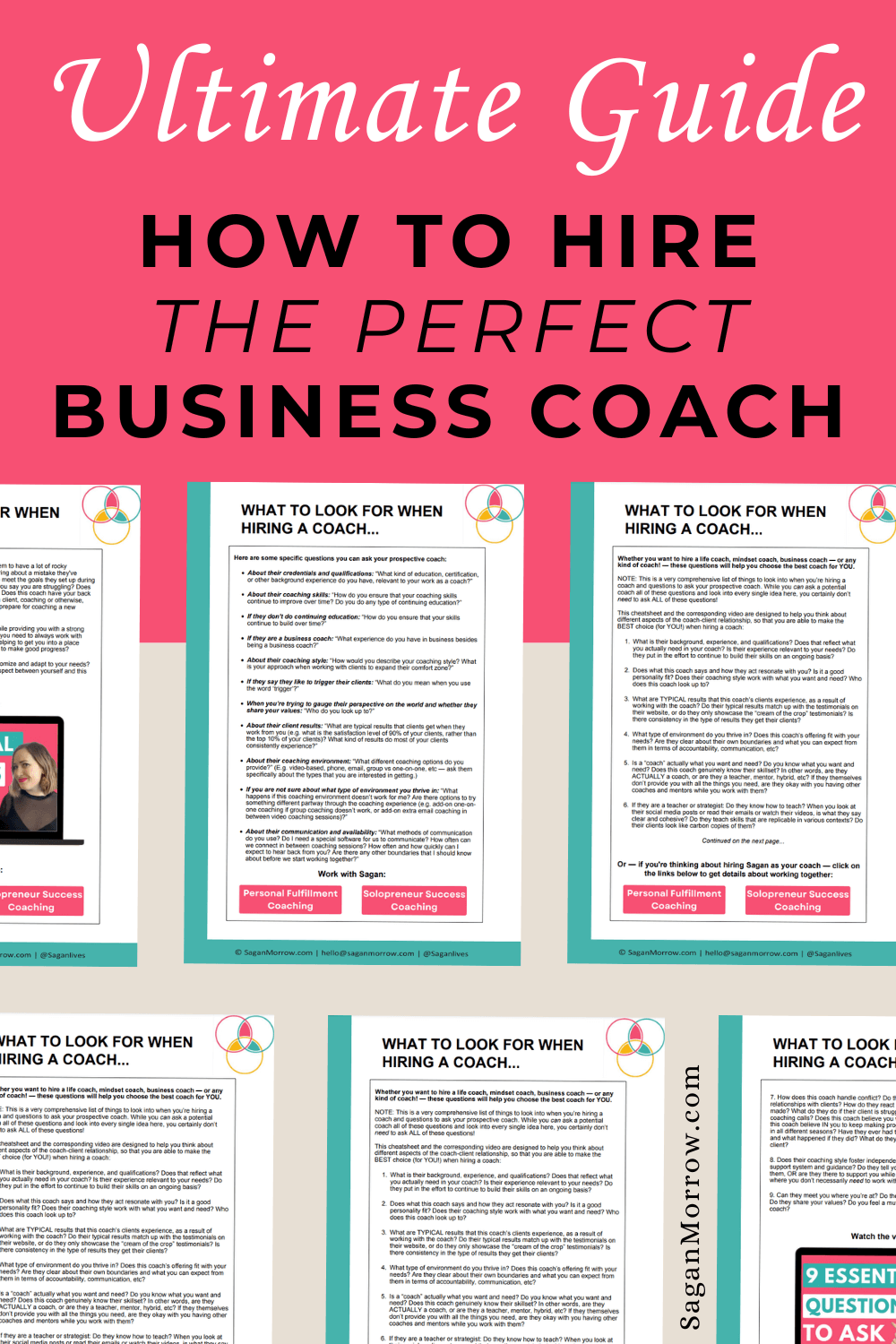
Whether you want to hire a life coach, a mindset coach, a business coach — or really any type of coach! — I have nine specific questions for you to take into consideration when you are choosing who to hire as your coach...
What you get in this Ultimate Guide article:
- Video version of this blog post (in case you prefer WATCHING to READING).
- Show notes with timestamps so you can easily go back to find what you need!
- The importance of a coach's background, experience, and qualifications.
- Expectations about continuing education.
- Red vs green flags.
- What to do if a coach does NOT include info about their qualifications on their website.
- The importance of RESONANCE with a coach.
- Why you should care about coaching styles.
- Example of my own coaching style.
- Should a coach "trigger" their clients?
- Values alignment with your coach.
- Typical results vs "cream of the crop" results.
- Questions to explore to determine what type of environment you thrive in.
- What to do if you don't know what environment you prefer.
- Boundaries for coaches and clients.
- What to do if you don't KNOW if a coach is the right fit for you.
- How a hybrid coaching model works.
- What you can say to confirm that this coach actually does COACHING.
- Why you should check that a teacher actually has the skill of teaching.
- Assessment of an expert's teaching skills.
- Difference between being good at MARKETING vs good at their SERVICES.
- The vital importance of customization.
- How to know if an expert has a great strategy, or if they just teach novelty.
- Handling conflict.
- A good test of a coach's character.
- How to make sure a coach will be there for you in all seasons.
- Is it a coach problem, or a client problem?
- Checking for a coach's preparation methods.
- Becoming self-led as a client
- The coaching relationship as a co-created experience.
- Does your coach need to have a similar "lived experience" as you?
- Recap of the essential questions to explore.
- How we can work together, if I'm the right fit for you!
Whew, that's a lot — hence why we're calling this the ULTIMATE GUIDE for how to choose who to hire as your coach!
Who am I to speak on this topic?
New around here? Hello and welcome! I'm Sagan, a Personal Fulfillment Coach and Solopreneur Productivity Coach.
I specialize in helping self-aware individuals improve their relationships with themselves, develop intrapersonal skills, create healthier work/life balance, and increase productivity using anti-hustle methods.
I have over 12 years of experience as a solo business owner, and I've been coaching clients as the main part of my business for the past few years.
Watch the video version of this article:
Show notes:
- 0:00 Introduction to hiring a great coach.
- 0:45 What to look for when hiring a coach, Question 1: What is their background, experience, and qualifications?
- 4:40 Important disclaimer about the red flags in coaching that I’m talking about throughout this video!
- 6:40 How to figure out who to hire as a coach, Question 2: Does what this coach says and how they act resonate with you?
- 11:55 What to look for when hiring a coach, Question 3: What are TYPICAL results that this coach’s clients experience, as a result of working with the coach?
- 13:44 Hiring a coach, Question 4: What type of environment do you thrive in?
- 17:18 How to hire a good business coach, Question 5: Is a “coach” actually what you want and need? Do you know what you want and need? ALSO: Does this person know their skillset? Are they ACTUALLY a coach, or are they a teacher, or are they a hybrid?
- 24:02 How to figure out who to hire as a coach, Question 6: If they are a teacher or a consultant or a strategist, do they know how to teach? Do they teach skills that are replicable in various contexts?
- 31:20 What to ask a potential coach, Question 7: How does this coach handle it if their client is struggling or there is a conflict?
- 34:55 The 3 awesome questions a client asked me BEFORE we started working together (and why YOU should ask your coach these questions, too!)
- 40:00 What to look for when hiring a coach, Question 8: Does their coaching style foster independence while providing you with a strong support system and guidance?
- 43:51 How to choose a coach, Question 9: Can they meet you where you’re at?
- 49:08 What other questions do you have about this topic? Drop your questions in the comments below (I might just turn it into a follow-up video!)
- 49:40 Recap of the top questions to ask when you are ready to hire a life coach or when you are hiring a business coach (or ANY type of coach!)
- 52:00 Now that you know how to choose which life coach you should hire ... You are READY to hire a coach! If i'm the right fit for you, I'd love to invite you to get coaching with me.
Let's dive into the top nine key questions that you need to ask to help you in choosing who to hire as your coach…
1) What is their background and their experience and qualifications?
Coaching is an unregulated industry (and it can feel like the Wild West!): This means that even if a coach does happen to have certification credentials, that doesn't necessarily mean that they are a good coach.
It doesn't really say anything about the certificate program that they took. The certification program that they took wasn't necessarily a good one.
Likewise, someone else might not have a coaching certificate, but they might have a lot of experience and background qualifications that do lead to them being an amazing coach.
For example, I am an internationally board-certified Life Coach. I also have a BA in Rhetoric, which is essentially a degree in critical thinking skills. As you can imagine, that helps a lot in my work as a coach!
I also have a background from many years ago as a Certified Holistic Nutritionist, so I have experience doing nutrition coaching and nutrition consulting — which has contributed to my current skills as a coach.
Throughout my work as an online business owner and as a freelance writer, doing all different types of work BEFORE I started coaching on personal fulfillment and solopreneur productivity, I also taught a lot of workshops and did a lot of presentations and worked in group settings, as well as one-to-one capacities...
...And all of that has also contributed to my abilities to coach people.
Because I've worked with so many different audiences, I've had to adapt my skill set to fit for those different contexts and to adapt for those various circumstances. I also do my own continuing education on an ongoing basis in skills such as Socratic questioning.
You can see how all of these different types of things can contribute to the skills of a coach. It's not necessarily just about having a certificate as a coach — that can be helpful, but it's not actually the be all and end all.
The continuing education piece of it is actually a really big one: You want to have a coach who is interested and willing to continue to develop their skills over time.
Expectations for continuing education
Coaching is one of those things that we never reach a point where we cannot improve upon it. We can always improve as coaches!
It is a green flag (in my opinion) if a coach wants to continue to develop their practice and their skills, if they are frequently working on their skills and continue to build it in the background.
That's a good sign that indicates that they truly care about providing you with the highest quality of service possible.
In that case, you can ask your prospective coach:
How do you ensure that your coaching skills continue to improve over time?
Do you do any type of continuing education?
If the coach has been coaching clients for a while, and if they completed a certification many years ago, are they continuing to develop their skills?
If they're not, that's okay! But you can also inquire as to how they are ensuring that their skills are continuing to grow:
Do they find that the simple act of coaching clients gives them the space and the opportunity to build their practice?
They should be able to answer that type of question as to how they continue to improve their own skills over time.
Also, if you're hiring a business coach, check that they actually have experience as a business owner beyond being a business coach (particularly because so many business coaches do a hybrid of coaching with consulting/mentorship). It may be a red flag if someone is doing business coaching, but they have never had any kind of business (or business experience) besides being a business coach.
Disclaimer about the red flags I mention in this video…
Throughout today's Ultimate Guide, I'm talking about possible things that might be red flag-y. I want to qualify that there could absolutely be instances when something is not a red flag; there might be other mitigating factors.
What we want to really focus on is, how can you determine what is the best fit for you from a particular coach?
You can use these questions and these topics of consideration for you as a roadmap to guide you and to help give you some direction.
And also, please know, this isn't the gospel! This is my opinion. I am a coach and I have been around the coaching industry for a while. These are my opinions that are not set in stone. So take what you will from this and use this as a guide for yourself.
What if coaches don't include information about their qualifications on their website?
When you are looking into different coaches, you'll probably be checking out their website to find out about their experience, their background, their qualifications, and their education — what can you do if they don't list that information listed?
Reach out and ask them about it!
You can ask them:
How long have you been doing this?
What are your qualifications?
What is your experience and your background?
A good coach will be willing to be open, honest, and transparent with you about their experience, qualifications, and credentials.
(Keep in mind that for client confidentiality purposes, there could be specific details they can't provide. However, they should still be able to provide education, credentials, or general qualifications)
There could be so many reasons as to why that's not listed on their website (e.g. they might have simply forgotten to update it!) — so again, it's not necessarily a red flag that they haven't listed that... but they SHOULD still be willing and able to answer your questions about it.
2) Does what this coach says and how they act resonate with you?
Personality fit matters A LOT with the coach-client relationship and the success of your coaching experience: the strength of the relationship that you have with your coach can be a major factor in the efficacy of the coaching experience.
If you do not like your coach, if you do not trust your coach, if you do not feel safe around them, if there is not mutual respect between you and the coach, it's going to affect the success of the outcomes of your coaching experience.
...And also it's just going to take away from your enjoyment of the entire experience. Find a coach who you connect with!
Coaching style MATTERS
This also includes taking into consideration the coach's coaching style.
For example, I am not a drill sergeant type of coach or a "tough love" type of coach — that's not just not my style. So if that's what you are looking for, if you really resonate with a drill sergeant sort of mentality, if you like the "tough love" style, then I will probably not be the right coach for you.
There is no right or wrong way when it comes to different coaching styles. They're just different! As a result, you just want to make sure that you are finding someone who you resonate with, and who DOES feel like a good fit for what you want.
What's my coaching style like?
My coaching style is very much about gently expanding your comfort zone so that you don't feel like you're being tossed out of a lifeboat without a jacket.
We want you to stretch yourself while still feeling safe and still having security — you aren't being tossed out there on your own!
Consistently what I hear from my clients is that they really, really appreciate the way that I compassionately challenge them. They grow by leaps and bounds while also feeling safe to do so.
We expand that comfort zone without tossing you out of it or getting you so far beyond your comfort zone that it's terrifying or that you freeze and aren't able to do anything.
Should a coach "trigger" their clients?
One of the things that I've noticed in the coaching industry is that there are a fair number of coaches out there who talk about how they like to trigger their clients. In my opinion, that's a bit of a red flag.
They often talk about it in the context of, “I want to trigger my clients because it gets my clients out of their comfort zone.”
That to me is, again, a red flag: You don't need to be triggered to expand your comfort zone. Being triggered is not necessary at all.
You do not need to be triggered to make awesome progress and stretch your comfort zone.
In my mind, the concept of being triggered also implies that you are not in a safe space. It's very important that your coach provides you with a safe space!
It also suggests — again, in my mind — that the coach may be trying to enforce or impose their dogma or their views onto you, which is not what coaching is about. Coaching is about finding the answers within you and helping you and supporting you and guiding you along the way.
Values alignment with your coach
Now again, a disclaimer here: Perhaps some of the coaches who use the word “trigger” aren't thinking about it in this context that I've just described. (I still think that it's a pretty bold claim to say that you WANT to trigger people)
The words we use matter a lot. This is especially true in the coaching industry, when we are working on internal thought patterns and beliefs.
Therefore, even if a coach is not intending to use the word “trigger” in a negative or a manipulative sort of way, it still has some connotations — and because our word choice matters so much, especially when it comes to coaching, that's kind of an underlying second red-ish flag.
Check in on that: Do they talk (or even brag) about how they like to trigger their clients?
If everything else they're saying and doing seems really great to you, and it seems like it’s a good fit — but they talk about how they like to trigger their clients — then in that case, I would suggest reaching out to them, maybe ask what they mean by that word trigger. Find out some more details because, again, maybe they are intending it in a different way.
When you're also looking at whether this coach feels like they resonate with you, another thing to consider is this:
Who do they look up to?
This can help you determine whether there is a good alignment of values.
If a coach looks up to someone in the world or the industry who you do (or do not) resonate with, that probably tells you something about this coach's values and their perspectives on things — and in that case, whether they make be or not be a good fit for you.
3) What are TYPICAL results that clients experience as a result of working with this coach?
This is a great question to ask to ask your coach:
What are the typical results that clients experience — not just the cream of the crop results?
If a coach can't answer that question, it might be a bit of a red flag.
...And if the TYPICAL results their clients get are different from the types of testimonials that the coach has on their website, that might also be a bit of a red flag — because in that case, they're not being super transparent. They're only putting the top 10% best results that their clients get from working with them.
What you really want to know is: What do 90% of clients experience as a result of working with this coach? That's what really matters.
What are the TYPICAL results, rather than the "cream of the crop" or outlier, amazing results?
For example, many of my clients say very similar things about working with me: They say they have increased confidence, motivation, and clarity. Multiple clients have said they were able to make more progress in a couple of sessions with me than they had an entire year on their own. This is reflected in the testimonials you see on my website.
When you visit my Coaching Client Case Studies and Testimonials page, you will be able to see that in the testimonials, my clients talk about the same types of things. There are a lot of patterns in the results they get.
This is a good thing because that indicates that there is consistency to the types of results that you can expect as a client, as well.
4) What type of environment do you thrive in?
For example...
- Do you work really well in a group with your peers?
- Do you work really well in a one-on-one, in a very personal, individual sort of capacity?
- Do you like doing more self-paced type of work and doing things on your own?
- Do you prefer being on video and seeing someone’s face as you're chatting with them — or would you prefer getting coaching via email or on the phone?
- Do you prefer real-time coaching — or would you prefer to be able to think about things, tell your coach about them via email or voice/text messaging, and then they get back to you after the fact (or perhaps you go back and forth throughout the course of the day)?
When you are looking at hiring a coach, you can ask them about the different options that they provide:
- Do they ONLY do video-based coaching?
- Do they also offer email-based coaching, if that's something that you want?
- If they have a group program, but you do not thrive in group environments, do they offer one-on-one coaching instead?
Make sure that the coach that you're thinking about hiring offers the type of coaching that suits your needs.
Just because they don't have the specific type of coaching you want listed on their website or social media platforms, that doesn't necessarily mean that they don't offer it. They might be able to customize something for you, or create a specific package just for you.
If you have a specific type of environment that you thrive in, and you found a coach that you're like, “Yes, this is the coach for me! I would love to work with them,” then reach out. Tell them what you're thinking about. Tell them what you're interested in and find out if that's something they DO offer (maybe behind the scenes), or if they will be willing to create it.
What if you don't know what type of environment you thrive in?
That's okay! I would still encourage you to reach out to your prospective coach. Let them know that you aren't really sure — you can have a conversation about that and express your concerns to them.
They might have recommendations for you with built-in flexibility to accommodate your needs over time. You might also be able to test things out for a little while to see how it goes; there could be room for adaptation.
Boundaries for coaches and clients
Ideally, when you're talking with a potential coach, they should be clear and upfront, transparent, communicative about what their boundaries look like.
For example:
- When and how often they're available to you.
- What you can expect from them in terms of your communication (especially if you are planning on working with them for a longer period of time — e.g. if it’s not just a single session, it might be a six months sort of coaching package)
- How often do you actually get the coaching?
- How much can you reach out to them in between sessions?
- Do they offer extra coaching in between sessions?
- If they'll do coaching in between sessions, how quickly will they typically respond to you?
Find out what their boundaries are so that you can set those expectations BEFORE you even start working together. You want to make sure you aren't going to be blindsided by any of this once you actually start working together.
Your potential coach should be able to tell you very clearly what their boundaries are, what their communication preferences are, etc.
5) Is a coach what you want or need — and do you even KNOW what you want and need?
If you aren't sure whether a coach will be a good fit for you, reach out to them:
- Tell them what you're struggling with.
- Tell them what you were hoping for from them.
- Tell them what you think you need help with and support/guidance on.
- Ask them if they think that they can help you.
- Ask them if they think they're coaching program would be a good fit.
They should be able to tell you whether they are a good fit for you. Or they might tell you, “You know what, you'll be better off seeing a therapist or going to a strategist or having a mentor.”
And by the way, it doesn't need to be either/or: You can have a coach AND a therapist AND a strategist AND a mentor AND a teacher, etc; you can have all of these different types of people. In fact, it can often work beautifully when you do have these different people in your life. Having these different types of support systems can be very beneficial.
In my opinion: If you're hiring a coach and they do not want you to work with anyone else, while you're working with them, that can be a bit of a red flag.
Ask them why that is.
Again, it might indicate that they want to impose their ideas on you.
Ideally, they should be adaptable and willing to work in a framework that assists you, that helps you, that best supports you. In my experience, coaching can work beautifully alongside and in conjunction with these other different experts and support systems.
Is this person actually a coach, or are they a teacher or a mentor or a hybrid?
Another way to get a well-rounded support system is to hire a coach hybrid.
For example, the type of coaching I do with my solopreneur clients is very much a hybrid model: We do coaching and consulting and strategizing and mentorship and teaching all blended together.
This is really helpful when we are reworking their business structure to create a lifestyle business model, building their anti-hustle productivity strategies, and helping them to unlearn toxic hustle culture mindset.
Depending on the specific client — and sometimes the specific session — we might use more of one piece of that compared to another. So with some of my clients or some of my sessions, they are very much coaching. In others, they might be a lot more mentorship focused or a lot more consulting focused. And other sessions might be kind of a hybrid or mix between the two.
It is entirely dependent on that particular client and what they need at that particular time. I really like to co create their experience with them.
If a client has a preference where they want more coaching or more mentorship or whatever it may be, then we do more of that. We always fit it to their wants and their needs.
And if they don't know what they want, that's fine too! I'll guide it: In that case, I can figure out what is needed and we lead the process from there. As long as my client is happy, as long as they're satisfied with what they're getting from the session experience, then we keep moving forward in that direction.
Again, when you're thinking about, “Who is it that I need? Do I want more coaching, or mentorship, or do I want a little bit of a hybrid of both, or do I want both but not necessarily in the same person?” — do a check in:
- Is this expert (who you're thinking of hiring) okay with that?
- Are they okay with you also getting coaching or mentorship (or whatever it may be) by someone else?
A good example: Because I work with clients on personal fulfillment AND ALSO internal business systems and productivity — we look at a lot of intrapersonal skills and mindset work, that deep internal work, as well as lifestyle business model and business foundations and personality based productivity — because of that, I often have clients from a wide range of different industries that I personally have no background in or knowledge of. And that's okay!
As a result of that, my solopreneur clients will often have mentors in their particular industry to support them in that (e.g. in growing their particular skill set). I think that this is great! This is a very client-centric approach:
If that is what is best for this particular client, then I am on board.
Check with your prospective coach: Are they okay with it if you are working with other people?
How do they react to that question? That also tells you a lot about their character.
If they aren't okay with it, at the very least find out WHY (there could be a good reason for it!) so that you can determine if this particular coach is suitable for you — or if it's maybe not a good fit after all.
Does this particular expert know their skill set?
Some people refer to themselves as a coach when they're actually more of a consultant. That's okay — it's not necessarily a red flag, because people use language differently.
But if that's the case, and if you know that you definitely 100% want coaching, check with the prospective coach in advance to find out: Do they actually offer coaching or not?
In this case, you can ask:
What is the process that you use with your coaching clients?
Do you help clients find the answers within themselves... or do you give your clients advice... or do you do both?
We are halfway through this ULTIMATE GUIDE of the top nine questions to help you choose who to hire as your coach...
Are you enjoying this so far? Is it helpful for you?
If so, give the YouTube video a thumbs up and hit that like button!
6) If the expert is a teacher or a consultant or strategist: Do they know what they're doing? (e.g. Do they know how to teach?)
Just because someone is good at something themselves, it doesn't mean they are good at TEACHING it.
This has been a huge problem, in my opinion, with the online course industry in general: We have a lot of people who are great at the service that they do for other people, they are really wonderful at a particular service and the work that they're doing in their industry…
...And then they are told that if they want to scale their business, they should start teaching other people to do what they do.
But they can't teach. They don't have the skill set of teaching. They are not, frankly, good teachers. And as a result, the online course industry has gotten a bit of a bad reputation.
Does this person know how to design a curriculum? It's really important that if you are hiring a teacher to help you that they do actually know how to teach.
How can you KNOW if a teacher can genuinely teach?
You can get a feel for this even by looking at their free content.
For example, if you are on this coaches or this teacher's email list, or if you follow them on social media, then look at their social media posts and our emails:
- Are they easy to understand?
- Does their free content flow together nicely?
- Does what they're saying make sense?
- Can you easily see how you get from point A to point B?
- Does it read well?
- Is it clear?
- Does this person use a combination of teaching concepts, as well as providing action steps?
Those are all good signs that they might have a genuine curriculum and SKILL at teaching.
Just because an expert is good at marketing, it doesn't mean they're good at teaching
Do you find that you need to always reread their work multiple times to try to understand it because it doesn't make sense or it is "word salad"? In that case, that could be a little bit of a red flag about their teaching ability.
Another example: When you read their emails or their social media posts, do you think to yourself, “I really want what they're selling, even though I don't actually know what exactly this is or how this is going to help me… but it SOUNDS really good!”
In that case, it might indicate that they have great marketing skills...
...but that doesn't necessarily mean that they have good teaching skills or coaching skills.
Just because someone is really good at marketing and sales, it does not mean that they are good at coaching, teaching, mentorship, etc.
They're completely separate skills:
Marketing is a skill. Coaching is a skill. Teaching is a skill. Mentorship is a skill. All of these are different skill sets.
Someone can have all of these skills, or they might only have one of these skills. So it's important to be able to tease that out and identify: “Does this person actually have this skill or not?”
If you find that you are really excited by the marketing, but it doesn't actually make sense for you — you don't really know what it is that they're even selling — then that probably indicates that their skill is much more about MARKETING than it is about necessarily TEACHING or COACHING, etc.
Customization is crucial: You are unique!
Another thing to consider is, does this teacher/coach teach skills that are replicable in various contexts?
For example, one of the issues I've seen in the online teaching space and the online coaching industry is that there are some individuals who are wonderful at being pioneers and leaders of the industry, in terms of trying something brand new that no one else has done before…
But here is where the problem comes into play: This would be fine IF the person was able to teach their skill: “Here's what I did. Now, here's how you can customize this and learn from this. Here's how it is replicable for you.”
What often happens, however, is that they rely on the fact that they were paving the way in the first place. They were the ones who paved the way.
They'll say, “This is what worked for me. I just did this and it worked amazing. I'm the first person who has ever done this.” That’s wonderful!
Then they will say, “Here's a step by step process for how you can do it too. I did this and it was wildly successful, so here's how you can do it as well.”
What happens is this: Other people try it and it works okay for them, but then more people try it and it starts working less and less and less.
This is because the initial person — without even realizing it — was successful BECAUSE it was the novelty of doing something new, that had never been seen before in the industry.
That is why they were successful in it.
...So when they teach other people to copy and paste exactly what they have done, it takes away the novelty of it and it stops working.
Anytime that someone is teaching you something based on “This is a novel thing that no one else is doing and therefore you should try this,” it will only work for so long until more people are doing it — and then it'll lose the novelty. The novelty will wear off and then it stops being successful.
I strongly encourage you to not rely on people who are teaching novelty-based trainings: You're always going to need to chase the next novel thing.
What happens here is that the exact method that was so successful the first time (or maybe even the second or the 10th time) starts to get diluted because more and more people are doing it.
How to tell if experts are teaching NOVELTY rather than sustainable strategies...
If you're not quite sure if a teacher or coach etc gives "novelty-based strategies" to their clients, one of the ways you can assess it is by looking at who their clients are:
Do the clients look like carbon copies of this teacher or coach?
If the clients all look and sound like their teacher or their coach or their mentor, then that indicates that they are essentially trying to mould you in their image.
They're not taking you, as an individual and a unique person, into account. Their methods probably won't be very adaptable to different scenarios; you're basically just going to be moulded to become yet another carbon copy.
In my opinion, if the clients all look like little carbon copies of that teacher or that coach, it could be a little bit of a red flag.
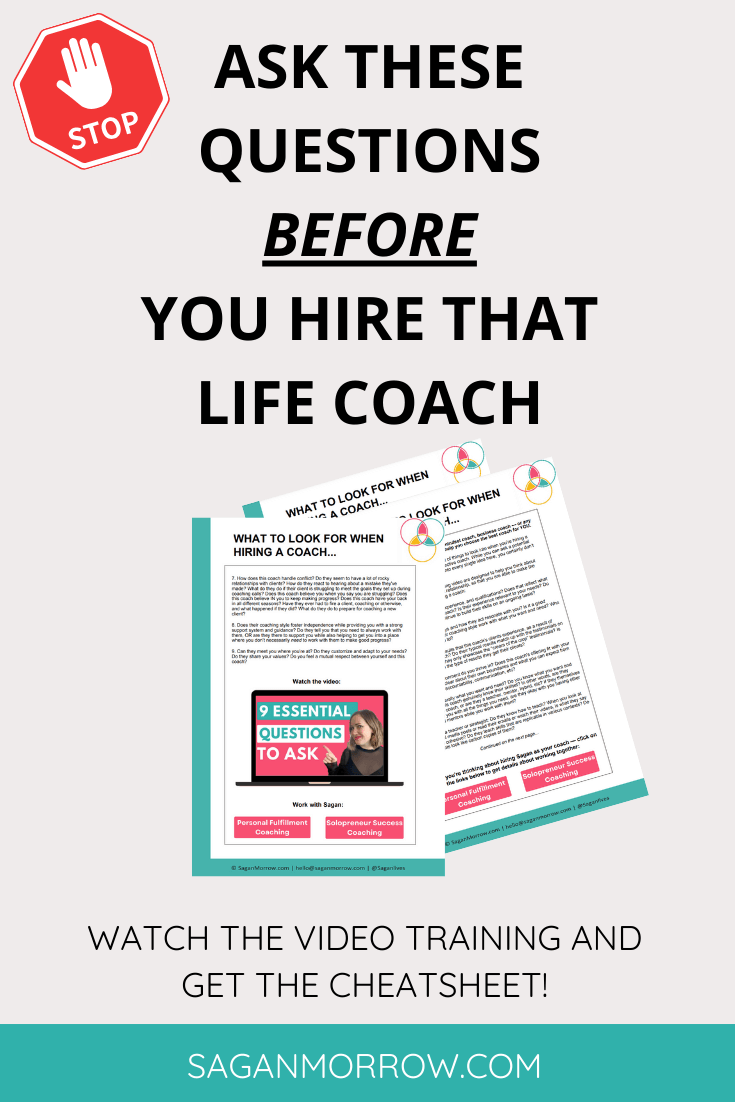
Click HERE to grab the cheatsheet.
7) How does this coach handle it if a client is struggling or experiencing conflict?
This says a lot about the coach!
You can also do some sleuthing to get an idea of how a coach might respond to those situations in advance.
For example, if a prospective coach talks a lot about how they constantly are dealing with haters, or if they always are talking about how they've had a lot of bad experiences with clients, or if you find that they are rude in the comment section of social media, or if they ignore legitimate concerns that people raise with them, those might all be a little bit red flaggy.
There was recently a conversation that happened on Threads that I thought was really interesting because of the conversation cropped up:
Someone said, “I'm looking at this coach’s web page and they have a typo at the top of the page… What should I do? Should I tell the coach that they have a typo on their website?”
What I found really interesting about this whole conversation is that people were reposting it and responding in the comments about their opinion. The responses were completely all over the place:
Some people were saying, “You should never tell someone that,” and other people were saying “Yes, you should tell them.”
Some people were saying, “I would love to know if I had a typo,” and other people were saying, “I think it's rude; I don't want to know and I don't care and it makes me more relatable if I have typos.”
To me, the real question here isn’t about “Should you tell someone they have a typo,” but rather:
How does the coach respond to you reaching out and letting them know there's a typo on their website?
A test of character
Exploring that kind of question is a good test of a person's character:
Do they react poorly to you reaching out to them? Or are they gracious about it?
The thing is, we're all human. Typos are a part of life. We are all going to make errors! We're all going to make typos; that's going to happen.
...But how does someone react, especially to being pointed out a typo on something that is very easy to change, such as a web page? How do they react to that?
If they do not react well, that tells you something about their character.
Do you want to work with a coach who can't handle being told that they have a typo?
I will also say, as someone who is an author as well, when readers reach out to me to tell me they’ve found a typo in a book — which happens very rarely, but a couple of times it’s happened — even though published books are a lot trickier to edit and re-upload (especially if you have paperbacks because there's a whole formatting issue), I really appreciate it when someone points those things out to me! I have documents to track those things: “If I publish another edition of this book, I know that I want to fix that typo.”
I want to know if I am making mistakes so that I can fix them.
And if someone has a hard time being told that they have a mistake on their website — which is extremely easy to fix — what does that tell you about their character?
Asking a coach directly how they handle client issues
In this context of, “How does a coach handle it if the client is struggling or if there's conflict?”, I had a client who reached out to me and they asked me three fantastic questions before we started working together.
(And by the way, she did hire me and we've worked together for a really long time now!!)
I loved that she asked these three questions before we started working together — and I would strongly recommend that you also ask any coach that you're considering hiring, ask them these three questions:
- How do you handle it if a client is struggling to meet the goals that you set during coaching calls?
- Have you ever had to fire a client, coaching or otherwise?
- How do you prep for coaching a new client?
Again, these are wonderful questions and your coach should be happy to answer each and every one of them. Let's break these down…
A) "How do you handle it if a client is struggling to meet the goals that you set up during your coaching sessions?"
Asking this question will help you to understand whether the coach is going to be there for you in all different seasons.
It also helps you to determine what processes they have, if any, to ensure that you actually DO meet the goals that you set up together during your coaching sessions.
Sometimes when I'm working with a client, they might be struggling with something and they'll say, “This probably sounds like an excuse, but here's what's going on with me.”
In that case:
- I work with the client to determine whether it IS an excuse or not, because those are two different things.
- If it is a so-called excuse, we use that as information and as an opportunity to figure out why that's happening.
I don't view client struggles as, "That's just an excuse, get over it."
If a client says, “I don't know if this is an excuse or not,” I'll reply, “Oh, this is interesting. Let's figure out what's going on here.”
And even if it is an excuse, there is always a reason for it. There's information in the struggle ♥
That's really important to me: I am never going to belittle my clients. I'm never going to brush them off. Instead, we're going to figure out what's going on so we can resolve it, together.
The question here is really:
- Does your coach believe you?
- Does your coach believe IN you?
- Does your coach have your back?
That's what I'm always all about. It is my literal job, as your coach, to work through that with you and to help you figure it out and get to the bottom of it — so that you can move on and move forward from there.
In other words, if a coach rolls their eyes at you, is dismissive of you, disrespects you, is rude to you, or tells you that “You are just making excuses,” that's probably a bit of a red flag.
Their job is to help you work through excuses and get to the bottom of it. If they are not willing to do that, then, in my opinion, they are not a very good coach.
Let’s move onto the next question that my client asked me before we started working together, that I again recommend that you also ask a coach…
B) "Have you ever had to fire a client, coaching or otherwise?"
As I mentioned earlier, how the coach talks about conflict tells you a lot about their character.
If they've had to fire a lot of clients, that probably means that they are the problem, not their clients — even if it's something as simple as they had some problems with communication and boundaries.
I also recommend following up this question by asking: “WHY did you fire that client, and what did that process look like?”
If they have never fired a client, ask them about that too: “Why have you never had to fire a client?” — because that can tell you whether the coach is conflict avoidant, or if they're just really good at mutually parting ways as needed (in which case the client doesn't need to be fired. They just needed to figure out a better situation for the package to maybe come to a close).
You can even follow this up with another question: “If you have not had to fire a client, what has happened when you and a client haven't quite seen eye to eye?” That's a really good question to get some insights, again, into how this coach handles conflict.
Let’s move onto the last question that my client had asked me before we started working together…
C) "How do you prepare for coaching a new client?"
This can help you get a sense for whether the coach genuinely cares about you as an individual, as well as how much they are customizing everything to your unique situation.
It also helps you get a good idea of what the expectations will be upfront: How well are they going to be prepared for that first session together?
8) Does this coach’s coaching style foster independence, while also providing you with a strong support system and guidance?
Some people have told me about not-so-great experiences they've had with past coaches, in which they would rely heavily on the coach to tell them what to do or they couldn't.
They felt like they couldn't make any decision on their own.
They always needed to go to their coach and say, “I need help figuring this stuff out.”
They felt like they needed to have a coach all the time in everything that they did.
Now, I am very happy to support my clients when they need my help. They hired me for a reason: to help them along the way! AND ALSO, I don't want them to feel like they cannot make any decisions without getting coached by me through the process.
What I like to do is this: I like to work with clients for at least six months (and ideally longer) because during that time frame, I will be coaching you a lot through the different types of things you might be experiencing, while also building your skills of self leadership and being able to elevate yourself.
A HUGE aspect of the work we do together is to increase intrapersonal intelligence and create space for self-discovery and self-reflection.
This is one of my favourite things that happens with my clients: Over time, as we're working together, they will start to come to some sessions and they'll say, “Ooh, this thing happened and this is how I dealt with it — I managed to coach myself through it!”
I love that. That's amazing. This is really good, because it gives that client evidence that they can do things on their own if they want to.
When my clients re-sign with me — when we maybe wrap up six months together and they decide at the end of the six months, “Yes, I want to hire you for another six months” — my goal is that they'll do it because it helps them and they WANT to continue coaching, rather than because they REQUIRE me at their side to make any kind of progress.
Rather than them thinking, “I can't do anything without Sagan. I need to have Sagan beside me at every step of the way,” instead it's much more about, “We had such a great experience working together, I can see how much more we can continue to do together for the next six months, and the next year.”
It's much more about the want, not necessarily the need.
And I LOVE working in a long-term capacity with my clients! If you want to get coaching with me for years on end, let's do it (there's always more that we can unpack together)... I just want to make sure that you are also able to make decisions and take action in between our sessions, too.
I specifically approach coaching to foster independence and to help you learn self coaching so as to gradually be more self-led — so that yes, you have me as your guide, as your support system, helping you out along the way, giving you that guidance, and you're also learning how to trust yourself and how to do this work independently.
When you continue to work with a coach for a really long period of time, it should ideally be because you like the opportunity to expand and level up even more, or because you want to revisit old issues to clear them up, or because you want to explore how much more you can CONTINUE to upgrade your skills.
It's wonderful when a coach helps you to build those self trust skills, those independent skills or self leadership skills, so that you are able to do this work on your own — even if you want to continue working with that coach as well.
9) Can this coach meet you where you're at?
Every individual is unique. Ideally, even if the coach has a specific curriculum that they like to follow or a roadmap they use, they should still ideally be willing to customize and adapt things to meet you where you are at.
In the coaching industry, many coaches say things like, “If you are a parent, then you should only ever hire a coach who also has children, because other coaches who are childfree will not understand your lifestyle.”
In my experience as someone who is childfree, and who has worked with many people who are parents, it's simply not true that a coach needs to ALSO be a parent in order to coach parents.
I have worked with so many different clients from all different backgrounds and lifestyles, industries and ages, education and goals. Some are parents of little kids, others are parents of adult children. Some are caregivers of their own parents. Some are childfree. Some are neurodivergent. Some have various health complications. Some are experiencing burnout. The list goes on.
None of that has affected my ability to coach them, because to me, the coaching relationship is a co-created experience. We always work from where you are at and take into account your unique situation, your unique goals, your unique wants and needs.
Now I do think that it likely helps that I personally have chronic anxiety, chronic nightmare disorder and chronic insomnia, and I did work as a live-in nanny many years ago, taking care of these little kids. So I do have that background and those types of experiences that I can relate to my clients' experiences. But even if that wasn't the case, it would still be possible to have an excellent coaching relationship.
Your coach does not need to have your exact lived experience in order to be a great coach for you. I have the very satisfied clients to prove it.
When should a coach have a similar lived experience to you?
The caveat to the above is that you certainly want to have someone who has the experience or qualifications, credentials and education, in the area that you're looking to get coached on.
This goes back to the very first question that we asked in this video: What is this coach's educational background, experience, and qualifications?
For example, I would not call myself a Parenting Coach. Just because I have experience as a live-in nanny, doesn't mean that I have the qualifications for coaching parents specifically on being a parent. So in that case, yes, you will probably want to get a coach who actually understands what life is like as a parent.
Maybe they wouldn't necessarily need to be a parent themselves, if they did have experience of working as a live-in nanny for an extended period of time or being educated in working with children, etc — because those different types of experiences could contribute to their skill set.
You can see how you want to take into consideration all of these different factors as to whether a coach will be a good fit for what you actually want and need.
Going back to this question of, “Can the coach meet you where you're at?”, it connects back to your values as well:
What values are most important to you, that you really want your coach to share?
What are the values that you absolutely 100% need your coach to agree with and share with you, in order for you to be able to work alongside one another?
This can also be about ensuring that you feel safe around your coach, especially if a particular value is related to something like human rights.
This is also why I make it very clear on my coaching webpages about some of my personal values: I talk about the fact that I support a woman's right to choose. I talk about how I support trans people. I talk about how I'm an alumnus of the Anti-Racist Leadership School. I also talk about the different organizations that I donate to.
As a result of those different types of things, you can get a feel for what my values are, you know where I stand on important issues, and therefore you can feel very comfortable determining whether I am that safe space for you.

Recap of the 9 essential things to look for when hiring a coach
There we have it! Those are the top nine things to take into consideration when you are wondering how to choose who to hire as your coach.
Let me know in the comments section of the YouTube video — or email hello[at]saganmorrow[dot]com — if this was helpful for you: What was your favourite part about all of this?
Keep me posted when you connect with a coach and if this is really helpful for you in actually hiring a coach!
If you have any other questions, feel free to drop them in the comments section on YouTube so that I can make another video. I'm happy to do a follow up video detailing any of this more or diving into another aspect of this whole topic.
To recap, those top nine questions include…
- What is their background and experience and qualifications?
- Does that reflect what you actually want from your coach?
- Is their experience relevant to your needs?
- Do they put in the effort to continue to build their skills on an ongoing basis?
- Does what this coach says and how they act resonate with you?
- Is there a good personality match between you and this coach?
- Does their coaching style work with what you want and need?
- Who does this coach look up to?
- What are typical results that clients get as a result of working with this coach, rather than just the "cream of the crop" results?
- Do their typical results match up with the testimonials they have on their website?
- Is there consistency in the type of results that their clients get?
- What type of environment do you thrive in?
- Does this coach's offerings fit your environment needs?
- Is this coach clear about their own boundaries, and what you can expect from them in terms of accountability and communication?
- Is a coach actually who/what you want and need?
- Do you even know what you want and need?
- Does this coach genuinely know their skill set? (In other words, are they actually a coach or are they more of a teacher or a mentor or a hybrid?)
- If they themselves don't provide you with all the things that you need, are they okay with you having other coaches or mentors that you work with while you're working with them?
- If they are a teacher or consultant or strategist, do they know how to teach?
- When you look at their social media posts or read their emails or watch their videos, is what they say cohesive?
- Do they teach skills that are replicable in various contexts?
- Do their clients look like carbon copies of them?
- How does this coach handle conflict?
- What do they do if their client is struggling to meet the goals that they set up during a coaching call?
- Have they ever had to fire a client, coaching or otherwise — and what happened if they did?
- What do they do to prepare for coaching a new client?
- Does their coaching style foster independence while providing you with a strong support system and guidance?
- Do they tell you that you always need to work with them, or are they there to support you while also getting you to a place where you don't necessarily need to work with them in order to make good progress?
- Can they meet you where you're at?
- Do they customize and adapt to meet your needs?
- Do they share your values?
- Do you feel like there is a mutual respect between yourself and this coach?
There you go — now that you know how to choose who to hire as your coach, you can get out there and hire a coach with confidence!
And remember...
You will be working closely with the coach you hire. It's important that you find someone who's a good fit for YOU, at this point in time.
It's okay to ask them lots of questions, kind of like an interview process, to make sure you're going to have a good working relationship.
Are you interested in working with me as your coach?
Click the buttons below to get more details about what that can look like — and if you're ready to get started, you can even book your sessions today:
Quick tip:
- If you are on a personal development, self improvement, and personal growth journey, Life Coaching for Personal Fulfillment is a great option for you (especially if you're already self-aware — and want to take your self-awareness skills to the next level).
- If you are a solopreneur who wants to escape toxic hustle culture and become a cozy business owner (or simply improve work/life balance, or create productivity systems that work for your unique personality and brain), Solopreneur Productivity Coaching is the best fit for you.
- If you want to get a sample "taste-test" of my coaching style (or tap more deeply into your intuitive guidance), the Activate Your Intuition masterclass is perfect for you.
Still not sure which one to choose? Email hello[at]saganmorrow[dot]com and let's discuss your best option!
I'm really looking forward to working with you!